
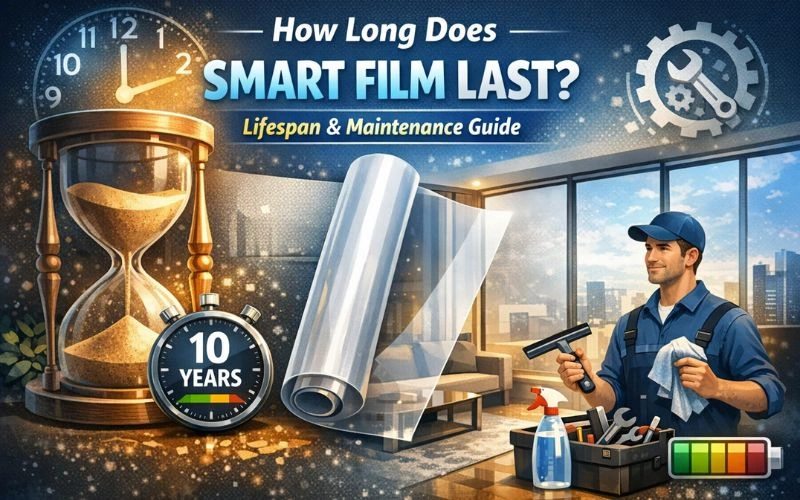
Smart film typically lasts 5 to 10 years, depending on film quality, installation standard, and environmental conditions. With proper care and a quality product, smart film can maintain its full performance for well over a decade, even in demanding climates like Pakistan.
The lifespan question is one of the most important things to understand before investing in smart film. It directly affects how you calculate the value of the installation. A product that lasts 5–10 years with minimal maintenance and delivers energy savings throughout that period is a very different proposition from curtains that need replacing every few years or blinds with mechanical parts that wear out unpredictably.
This guide covers everything you need to know about smart film lifespan in Pakistan, what affects it, how to extend it, and what maintenance actually looks like day-to-day.
Planning a smart film installation?
What Affects the Lifespan of Smart Film?
Smart film lifespan is not a fixed number, it is a range that varies based on four key factors. Understanding these helps you make a better purchasing decision and manage the installation correctly from day one.
Quality of the Smart Film
Film quality is the single biggest determinant of lifespan. Entry-level smart films use lower-grade PDLC formulations and thinner outer layers, meaning optical performance degrades faster under repeated use and UV exposure.
Premium-grade smart film uses higher-quality liquid crystals, more durable laminate layers, and stronger UV-stabilised coatings. These films maintain their switching speed, clarity, and opacity for significantly longer. Manufacturers of premium films typically back this with warranties of 7 to 10 years, a reliable indicator of actual expected performance.
Installation Process
Even a high-quality smart film will underperform if installed incorrectly. The most common installation issues that affect lifespan include: improper surface preparation (dust or moisture under the film causes bubbling and edge lifting), poorly sealed film edges (which allow moisture ingress over time), and substandard electrical connections that cause voltage fluctuations damaging the PDLC layer.
Professional installation, using proper surface cleaning, correct film sizing, sealed edges, and a stable power supply, is essential for achieving the full expected lifespan.
For a full overview of how installation works, read our guide on how smart film works and installation basics.
Usage Frequency
Smart film is designed for frequent switching, that is its core function. Standard daily switching is completely within its design specification. Where usage patterns matter is in environments with continuous, rapid switching, for example, a motion sensor switching the film every few seconds throughout the day. For normal home and office use with manual or timed switching, usage frequency is not a significant factor in lifespan.
Environmental Conditions
Pakistan’s climate presents a real test. Extreme summer heat, intense UV radiation, monsoon humidity, and dust all affect smart film performance over time. Prolonged UV exposure can cause gradual yellowing in lower-quality films. High humidity can accelerate edge lifting if the film is not properly sealed.
High-quality smart film is engineered for these conditions. Premium films carry UV-resistant coatings and are rated for operating temperatures well above what Pakistani glass panels reach even in peak summer.
For a detailed assessment, read our guide on smart film performance in extreme weather.
Is Smart Film Durable in Pakistan’s Climate?
Yes, quality smart film is durable in Pakistan’s climate. It is specifically engineered for high-temperature, high-UV environments, and premium products perform reliably across Pakistan’s full range of seasonal conditions.
High Temperatures
Pakistan’s summer temperatures regularly exceed 40°C in cities like Lahore, Multan, and Jacobabad. Glass surfaces in direct sunlight can reach 60–70°C. Premium smart films are rated for operating temperatures of up to 70–80°C. The PDLC layer remains stable, it does not bubble, warp, or lose switching function under normal summer heat exposure.
UV and Sunlight Exposure
Pakistan receives some of the highest annual solar radiation in the world. UV exposure is the primary cause of long-term colour change in smart film. Premium-grade films address this with UV-stabilised coatings that filter the UV spectrum before it reaches the PDLC layer. Budget films without these coatings will show visible yellowing within 3–5 years of heavy sun exposure.
Dust and Pollution
Smart film’s smooth glass surface does not trap dust the way blinds or curtains do. Regular light cleaning prevents any surface build-up from affecting optical clarity. Dust is a maintenance consideration, not a durability threat, for properly installed smart film.
Monsoon Humidity
Properly installed smart film with fully sealed edges handles monsoon-season humidity without issue. The risk arises only when film edges are poorly sealed, another reason professional installation matters.
Read about how smart windows keep homes cooler during Pakistan’s extreme summer heat.
Maintenance Guide: How to Extend Smart Film Lifespan
One of smart film’s most practical advantages is that its maintenance requirements are minimal. No moving parts, no fabric to wash, no mechanical components to replace. The following practices will keep your smart film performing at its best throughout its full expected lifespan.
Clean with Soft, Non-Abrasive Materials
The glass surface over smart film cleans like any standard glass, a soft, damp microfibre cloth is ideal. In dusty Pakistani environments, a light weekly wipe is sufficient. Avoid abrasive cloths or rough sponges, which can scratch the glass surface and, over time, affect the clarity of the film beneath.
For a complete step-by-step cleaning process, read our dedicated guide on how to clean smart film properly.
Avoid Harsh or Ammonia-Based Chemicals
Standard glass cleaners containing ammonia should not be used on smart film. Ammonia can penetrate microscopic edge gaps and degrade the film’s adhesive layer and PDLC formulation over time. Use a mild, diluted soap solution or a purpose-made film-safe glass cleaner. Plain water on a soft cloth is always safe.
Handle Electrical Components Carefully
Keep the power supply unit away from direct water exposure. Do not allow cleaning water or condensation to enter the wiring connections. In high-humidity rooms like bathrooms, ensure electrical components are positioned away from direct moisture contact.
Regular Inspection of Edges and Wiring
A brief monthly inspection takes under five minutes. Check that film edges remain flat against the glass with no lifting or bubbling, particularly in corners and along the bottom edge. Any edge lifting caught early can be re-sealed before moisture penetrates. For wiring, check that connections are secure and cable runs are not kinked or near heat sources.
Does Smart Film Lose Quality Over Time?
Yes, all smart film experiences some gradual change over many years. The most common change is a slight increase in the opacity of the transparent state, meaning the film in ‘clear’ mode after 8–10 years may be very slightly less optically transparent than when first installed. In premium-grade films, this is barely perceptible under normal viewing conditions.
Switching speed can slow marginally over time as the PDLC layer ages. In standard use, this change is measured in fractions of a second and has no practical impact.
The most significant quality-affecting factor is UV degradation, which in lower-quality films can cause visible yellowing within 5–7 years of heavy sun exposure. Premium films with UV-stabilised coatings resist this effectively throughout their rated lifespan.
In practical terms, a quality smart film installed professionally in Pakistan should remain fully functional and visually satisfactory for 8–10 years without visible quality degradation under normal use conditions.
Smart Film vs Traditional Privacy Solutions: Durability Comparison
Curtains have the shortest useful lifespan, fading, fabric wear, and rod deterioration typically require replacement within 2–5 years in Pakistani conditions. Blinds last a little longer but suffer from mechanical failure. Frosted glass is permanent but inflexible.
Smart film sits in the best position: 5–10+ year lifespan with minimal maintenance, full flexibility for the duration, and the ability to replace just the film layer if needed without replacing the glass.
See the full feature-by-feature breakdown: Smart Film vs Curtains vs Blinds: Which Is Better for Privacy?
Is Smart Film Worth It Long-Term?
Smart film delivers three distinct categories of value over its lifespan. First, functional value: on-demand privacy, from day one to year ten, without any degradation in the core switching function. Second, energy value: smart film reduces solar heat gain through your glass surfaces, lowering AC load throughout every Pakistani summer for the full lifespan of the installation.
Read our detailed breakdown of how smart film reduces electricity bills in Pakistani homes and offices to understand the scale of these savings.
Third, maintenance value: every year without a curtain washing cycle, a blind replacement, or a frosted glass re-treatment is a year where smart film’s low-maintenance advantage compounds. Over a decade, the time and money saved on maintenance is a genuine financial benefit.
If you are still assessing whether smart film is the right investment for your specific situation, our detailed guide on Is Smart Film Worth It in Pakistan covers real costs, honest verdicts, and the full long-term value calculation.
Where Smart Film Lasts the Longest: Best Use Cases
Indoor Glass Partitions
Protected from direct outdoor weather and consistent UV exposure, indoor partitions allow smart film to operate in near-ideal conditions. Installations in controlled indoor environments regularly achieve 10+ year lifespans with no performance issues.
Offices and Boardrooms
Office environments offer consistent temperature control, limited direct sun exposure, and regular professional cleaning, highly favourable for smart film longevity.
For a full look at smart film in office settings, read our guide to smart office privacy solutions.
Bathrooms and Interior Glass Doors
With proper professional installation, including full edge sealing and moisture-resistant power supply positioning, bathroom smart film performs reliably and achieves its full rated lifespan.
South-Facing Windows In Direct Sunlight
This is the most demanding environment for smart film in Pakistan. Film quality matters most here. Premium UV-stabilised films handle this exposure without visible degradation throughout their rated lifespan. For direct-sun glass panels, a premium film grade is essential.
The International Glazing Database (IGDB) maintained by Lawrence Berkeley National Laboratory provides detailed technical data on solar performance properties of window films, the same data used by architects when selecting glass solutions for Pakistan’s climate conditions.
Final Verdict: How Long Does Smart Film Last?
Quality smart film professionally installed lasts 5 to 10 years as a baseline, with premium-grade products routinely exceeding this under good conditions. In optimal indoor environments like offices and partitions, 10–15 year lifespans are achievable.
The maintenance required to achieve this lifespan is genuinely minimal: light regular cleaning, occasional edge and wiring checks, and avoiding harsh chemicals. No annual service requirements, no part replacements, no professional visits needed under normal operating conditions.
Key Takeaways:
- Lifespan: 5–10 years standard; 10–15 years possible with premium film in ideal conditions
- Pakistan climate: Premium smart film handles Pakistan’s heat, UV, and humidity without issue
- Maintenance: Minimal, soft cloth cleaning, occasional edge and wiring checks
- Energy savings: Reduces AC load throughout the full lifespan, compounding long-term value
- Long-term value: Outperforms curtains and blinds on total cost of ownership over 5–10 years
Smart film is a long-term investment in your space, and with the right product, professional installation, and basic care, it delivers consistent, high-quality performance for a decade or more in Pakistan’s demanding climate.
Frequently Asked Questions (FAQ)
Q: Does smart film wear out?
A: Yes, like any technology, smart film experiences gradual wear over time. The most noticeable change in older film is a slight reduction in optical clarity of the transparent state, and marginally slower switching speed. In premium-grade films, these changes are barely perceptible throughout the rated lifespan. Entry-level films may show more visible degradation, particularly in high-UV direct-sun positions without UV-stabilised coatings.
Q: Can smart film be replaced if it wears out?
A: Yes, the film layer can be replaced without replacing the glass. If your smart film reaches the end of its useful life, a technician removes the old film, prepares the glass surface, and applies new film at significantly lower cost than a new glass panel. The electrical wiring and controller can typically be reused. This makes smart film a genuinely upgradable solution.
Q: Is smart film safe in Pakistan’s heat?
A: Yes. Premium smart film is rated for operating temperatures of 70–80°C, covering the surface temperatures Pakistani glass panels reach even in the most extreme summer conditions. The PDLC layer remains stable and functional at these temperatures. Budget-grade films without proper heat-resistant formulations may show performance issues, which is why investing in a quality product matters for Pakistani installations.
Q: How often should smart film be cleaned?
A: In Pakistan’s dusty urban environments, a light wipe with a soft damp cloth once a week is sufficient. In cleaner environments, every two weeks is adequate. Avoid ammonia-based glass cleaners. A mild soap solution or plain water is always safe. Deep cleaning is rarely needed, smart film’s smooth glass surface does not accumulate grime the way blinds or curtains do.
Q: Does smart film consume electricity continuously?
A: Smart film only consumes electricity when it is in its transparent (clear) state. In its default opaque state, no power is needed. Electricity consumption during operation is very low, approximately 5–7 watts per square metre, less than a standard LED bulb. More importantly, smart film saves significantly more electricity through reduced solar heat gain and lower AC usage than it consumes to operate. The net energy impact is positive.