
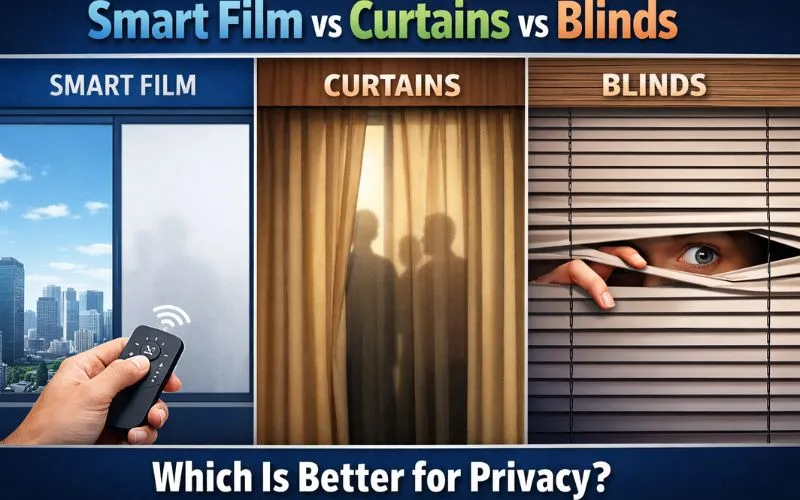
Smart film is better than curtains and blinds for privacy, aesthetics, and long-term value, but curtains and blinds still have a place for budget-conscious or temporary setups. When comparing smart film vs curtains vs blinds, the right choice depends on how modern you want your space to feel, how much control you want over privacy and light, and what your budget allows.
Curtains and blinds have served as the default privacy solution in Pakistani homes and offices for decades. They work, but they come with real drawbacks: bulky fabric, dust accumulation, partial coverage, and an increasingly outdated look. Smart film solves all of these problems in one installation.
This guide gives you an honest, side-by-side comparison of all three options, so you can choose the best privacy solution for your specific space.
Not sure which option suits your space?
What Is the Best Privacy Solution for Modern Spaces?
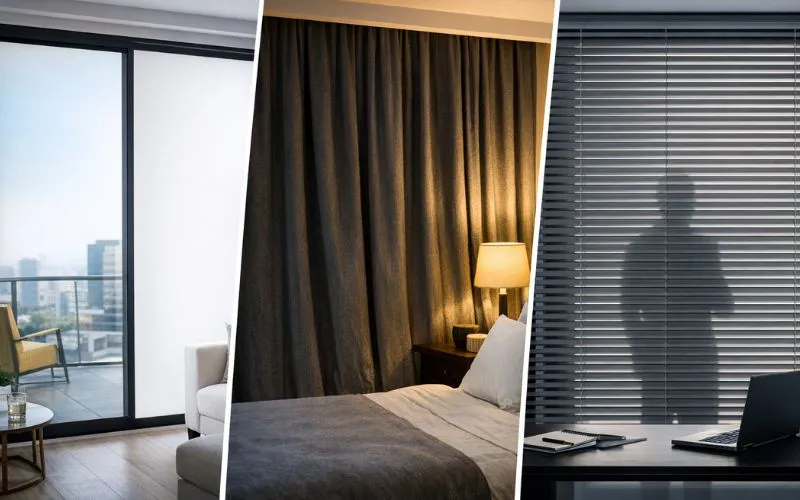
Privacy is no longer just a practical need, it is a design statement. Whether it’s a home bedroom, a glass-walled office, a retail store, or a hospital consultation room, how you control privacy directly affects how the space looks and feels.
Traditional solutions like curtains and blinds were designed for a different era of interiors. Today’s modern spaces, with open plans, floor-to-ceiling glass, and minimal design, demand a solution that keeps up. That is where smart film changes the equation entirely.
The best privacy solution for modern spaces is one that gives you full control, maintains natural light when privacy is not needed, requires minimal maintenance, and looks premium. Smart film ticks every one of those boxes. Curtains and blinds tick only some.
What Is Smart Film and How Does It Work?
Smart film is a thin, electrically controlled privacy film applied directly onto existing glass surfaces. It uses PDLC (Polymer Dispersed Liquid Crystal) technology. When power is supplied, the liquid crystals align and the glass becomes fully transparent. When the power is cut, the crystals scatter and the glass turns opaque, delivering instant, complete privacy.
There are no curtain rods, no fabric panels, no slats to adjust. Just a clean glass surface that switches between clear and private with a single touch, or automatically on a timer or smart controller.
For a full technical explanation, read our guide on how smart film works.
Curtains vs Blinds vs Smart Film — Quick Comparison
The table below provides a full side-by-side comparison across the factors that matter most when choosing a privacy solution.
The table tells a clear story. Curtains and blinds win on upfront cost. Smart film wins on every other dimension, privacy quality, light control, aesthetics, maintenance, durability, and energy performance.
Privacy Comparison: Which One Performs Better?
Privacy is the core function all three solutions are supposed to deliver. But they deliver it in very different ways, and with very different trade-offs.
Curtains: Basic Privacy but Limited Control
Curtains provide privacy by covering the window entirely, but only when they are fully closed. The moment you want natural light in the room, you lose all privacy. There is no middle ground. In rooms like living areas or kitchens where you want to keep the space bright and open during the day, curtains either block the light or expose the interior.
Curtains are also bulky. In smaller rooms or modern minimalist interiors, heavy fabric panels look out of place and collect dust quickly. In Pakistan’s hot and dusty climate, curtain maintenance is a genuinely time-consuming task.
Blinds: Adjustable but Not Fully Private
Blinds offer more control than curtains: you can angle the slats to manage light without fully closing them. But that adjustment comes with a persistent problem: gaps. Even when fully closed, most blinds leave visible gaps between slats, meaning passersby can still see through at the right angle. For spaces requiring true privacy: bathrooms, boardrooms, consultation rooms: blinds fall short.
Blinds also attract dust at a disproportionate rate due to their horizontal surfaces and mechanical slats. In Pakistani homes and offices with year-round dust and pollution, cleaning blinds is a repetitive, time-consuming chore.
Smart Film: Instant Privacy with One Click
Smart film delivers complete, gap-free privacy the moment it is switched to opaque mode: and full natural light when switched to transparent. There are no gaps, no fabric panels blocking the view, and no manual adjustment required. One switch, and the glass goes from a wide-open transparent panel to a frosted privacy surface instantly.
Critically, smart film does not sacrifice light for privacy. When privacy is not needed, your glass is fully clear: the room stays bright, open, and connected to the outside. This is something neither curtains nor blinds can offer.
For a detailed look at what this means for your home or office, read about the full range of privacy glass benefits.
Which Option Looks Better in Modern Interiors?
Aesthetics matter as much as function, especially in client-facing offices, hospitality spaces, and modern homes where the interior design makes a strong statement.
Curtains
Curtains carry an undeniably traditional feel. In certain bedroom styles or heritage-inspired interiors, they work well. But in modern minimalist spaces, glass-walled offices, or contemporary homes, fabric curtains look dated and heavy. They also interrupt the visual flow of the room and reduce the perceived size of the space.
Blinds
Blinds are a step forward from curtains in terms of modernity, they are slimmer, more geometric, and available in cleaner finishes. In functional office environments, they do a reasonable job. But they still have visible hardware, mechanical rails, and a utilitarian look that falls short of premium.
Smart Film
Smart film is invisible when it is not needed. When the glass is clear, there is no film to see, just clean, open glass. When switched to opaque, it presents a smooth, uniform frosted surface without any texture variation, hardware, or rails. The result is a finish that looks genuinely premium and integrates seamlessly with any modern interior design language.
See why interior designers prefer smart film over traditional privacy solutions for high-end residential and commercial projects.
Which One Saves More Energy?
In Pakistan’s extreme climate, where summer temperatures regularly exceed 40°C, the energy performance of your privacy solution has a real impact on your electricity bills.
Curtains block light but do not meaningfully reduce the solar heat passing through glass. Heavy curtains trap heat between the fabric and the glass, which can actually increase room temperature. Blinds offer slightly better ventilation but provide minimal thermal insulation against solar heat gain.
Smart film actively reduces solar heat gain by blocking a portion of infrared radiation from passing through the glass. This means less heat enters the room, your air conditioning runs for shorter cycles, and your electricity bills reduce, particularly in south-facing rooms and large glass-fronted offices that take the full force of Pakistan’s summer sun.
Read about how smart film helps Pakistani homes and businesses reduce electricity bills with smart film throughout the year.
The World Green Building Council’s guidance on energy efficiency consistently highlights smart glazing technologies as one of the highest-impact ways to reduce a building’s cooling energy demand, a finding directly relevant to Pakistan’s energy challenges.
Maintenance & Cleaning Comparison
The maintenance burden of your privacy solution adds up over months and years. Here is how the three options compare in practical, everyday terms.
Curtains
Curtains require regular removal and washing, typically every few months in dusty Pakistani environments. Heavy curtains need professional dry cleaning. Fabric absorbs odours and allergens over time. Curtain rods and hooks need occasional adjustment. The overall maintenance effort is high relative to the function curtains provide.
Blinds
Blinds collect dust on every horizontal slat surface. In a single week of normal use in a Pakistani city, blinds accumulate a visible layer of dust that requires wiping down slat by slat. The mechanical components, cords, brackets, tilting mechanisms, are prone to wear and often need replacing within a few years.
Smart Film
Smart film requires almost no maintenance. The surface is smooth glass, wipe it down with a soft, damp cloth when needed. There are no moving parts, no fabric to wash, and no mechanical components to replace. The film itself is sealed and protected. Periodic checks of the electrical connections take under a minute.
For complete care instructions, read our guide on how to clean smart film to keep it performing at its best.
Best Use Cases for Each Option
Each solution has situations where it genuinely makes sense. Here is an honest breakdown of where each one performs best.
Curtains: Best For
- Budget bedrooms and guest rooms where aesthetics are secondary
- Spaces with no glass partitions, traditional window setups with deep sills
- Heritage or traditionally decorated interiors where fabric adds warmth
- Very low-budget rental spaces where quick, removable solutions are needed
Blinds: Best For
- Basic office environments where cost is the primary driver
- Spaces needing adjustable light control without full privacy
- Temporary setups in rental offices or short-term commercial leases
Smart Film: Best For
- Glass-walled offices, boardrooms, and meeting rooms
- Bathrooms and bedrooms where privacy and natural light both matter
- Glass partitions in open-plan homes and commercial spaces
- Hospitals, clinics, and consultation rooms requiring switchable privacy
- Retail storefronts and display windows
- Any space where premium aesthetics and minimal maintenance are priorities
Find out exactly which rooms in your home need smart film for the best results and return on investment.
When Curtains or Blinds Might Be the Better Choice
Smart film is not always the right answer, and being honest about this matters. Here are the situations where curtains or blinds are a more practical choice.
- Very tight budget: If your budget is low and you need a quick privacy fix, a curtain or blind is the realistic option. Smart film requires a higher upfront investment.
- Temporary or rental spaces: If you’re in a short-term rental or a space you plan to vacate soon, the investment in smart film may not make financial sense. A simple blind gives you functional coverage without commitment.
- No electricity access at the glass: Smart film needs power. In a space where running electrical wiring to the glass location is impractical or very expensive, curtains or blinds remain the simpler solution.
- Non-glass surfaces: Smart film only works on glass. For fabric partitions, wooden screens, or non-glass dividers, curtains and drapes remain the relevant option.
The goal is always to match the right solution to the right situation. The RIBA guidance on interior glazing solutions reinforces this, material choice should always match building use, occupancy pattern, and budget, not just aesthetics.
Final Verdict: Smart Film vs Curtains vs Blinds
When comparing smart film vs curtains vs blinds across every dimension, privacy quality, aesthetics, energy performance, maintenance, and long-term value, smart film is the superior solution for modern spaces. The comparison is not close.
Curtains and blinds are not bad products. They are functional solutions for specific situations. But for anyone investing in a home renovation, office fit-out, or commercial upgrade who wants a result that looks genuinely premium and performs better over time, smart film is the clear winner.
Choose Smart Film If You:
- Want modern, instant privacy with no curtain rails, rods, or bulky fabric in sight
- Need privacy AND natural light? Smart film gives you both
- Want to reduce energy bills through better solar heat management in Pakistan’s climate
- Are you renovating or fitting out a home, office, boardroom, or commercial space
- Want a long-term solution that lasts 5–10+ years with minimal maintenance
Stick With Curtains or Blinds If You:
- Have a very limited budget and need a quick, low-cost temporary privacy fix
- Are in a short-term rental and cannot make modifications to the glass
- Have no electrical access at the glass location, and wiring is impractical
Smart film is the best privacy solution for any modern home or office in Pakistan, delivering instant privacy, better energy performance, and a premium finish that curtains and blinds simply cannot match.
Frequently Asked Questions
Q: Is smart film better than curtains?
A: Yes, for most modern spaces, smart film is significantly better than curtains. It provides complete privacy on demand without blocking natural light when privacy is not needed. It requires no washing or regular maintenance, looks far more premium, and helps reduce energy costs. Curtains are only the better choice when budget is very limited or the setup is temporary.
Q: Can smart film replace blinds?
A: Yes. Smart film replaces blinds entirely and does the job better. Blinds leave gaps, collect dust, and have mechanical parts that wear out. Smart film switches from fully transparent to completely opaque with no gaps, no moving parts, and no dust traps. It is a direct upgrade from blinds in any glass-based application.
Q: Does smart film block sunlight completely?
A: Smart film in its opaque state significantly reduces light transmission and blocks the view from both directions. It does not block 100% of light, some ambient light passes through, similar to a frosted glass effect. This is actually a benefit: even in privacy mode, the room retains natural brightness without being in full darkness.
Q: Is smart film good for bedrooms?
A: Yes, bedrooms are one of the best applications for smart film in Pakistan. During the day, you can keep the glass fully transparent to maximise natural light and views. At night or when privacy is needed, one switch makes the glass completely opaque. No curtain tracks, no fabric maintenance, and no bulky panels disrupting your bedroom design.