
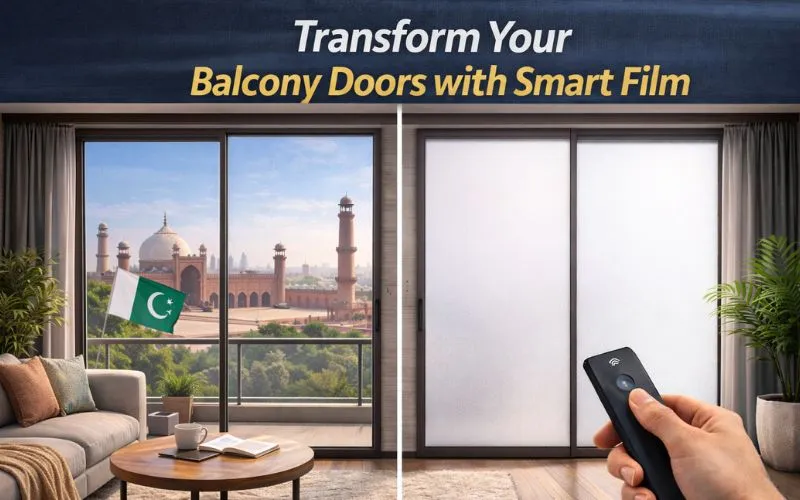
Your balcony doors work hard. They let in sunlight, frame your view, and take the full force of Pakistani summers, yet most homeowners are still covering them with curtains that sag, collect dust, and do nothing against heat. Switchable smart film changes that. It applies directly to your existing glass, turning any balcony door into a privacy-controlled, heat-blocking surface you operate with a single switch.
Whether you have a sliding glass door, a hinged balcony door, or a full floor-to-ceiling glass panel, smart film retrofits onto the surface without replacing the glass. The privacy glass benefits alone make it worth considering, but for balcony applications specifically, the advantages go well beyond privacy.
Ready to upgrade your balcony doors with instant privacy control?
Why Balcony Doors Are the Hardest Glass to Cover
Curtains and blinds work on fixed windows. They fail on balcony doors. Sliding doors have no good track for fabric. Hinged doors catch on curtain panels every time they open. Retractable blinds either block the entire view or leave gaps on the sides. The result is that most balcony doors in Pakistani apartments are either left bare, giving neighbours a clear line of sight, or covered with heavy drapes that turn a bright space dark.
Balconies also face direct sun exposure for long stretches of the day. South and west-facing balconies in Lahore, Karachi, and Islamabad can heat up a living room by several degrees, pushing air conditioning loads higher. Traditional window treatments do not address this heat problem at all.
How Switchable Glass Film Works on Balcony Doors
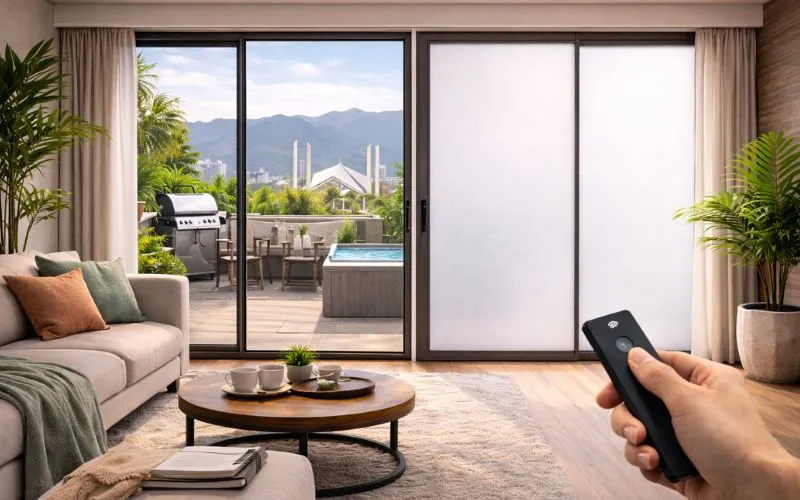
The technology behind switchable glass film is a layer of liquid crystal particles suspended between two thin film sheets. When power flows through the film, the crystals align and the glass goes fully transparent. Cut the power, and the crystals scatter, turning the surface a clean opaque white.
For balcony doors, this means you get full transparency when you want the view and full privacy when you need it, in under 0.1 seconds. The film handles both functions that curtains can never manage at the same time: blocking visibility without blocking light.
Installation takes 2 to 4 hours per door depending on size. The film adheres to the existing glass surface with no frame replacement, no structural work. Wiring runs discreetly along the frame and connects to a wall switch, remote, or smartphone app.
Key Benefits for Pakistani Balcony Doors
- Privacy on demand: Switch from clear to opaque in under a second. No adjusting, no cord-pulling, no gaps.
- Heat reduction: Smart film blocks a significant portion of solar heat gain, helping reduce electricity bills from reduced AC load, critical during Karachi and Lahore summers.
- 99% UV protection: Blocks harmful ultraviolet rays that fade flooring, furniture, and soft furnishings.
- Natural light retained: Even in opaque mode, diffused light still passes through. The space stays bright, not dark.
- Works on sliding and hinged doors: No curtain tracks, no clips, no hardware.
- Multiple control options: Wall switch, remote, smartphone app, or integration with smart home systems.
- Low maintenance: A simple wipe-down is all it needs. No fabric laundering, no dusting blinds.
Self-Adhesive vs Non-Adhesive: Which Works for Balcony Doors?
Smart Film Solutions offers two installation types. Self-adhesive film uses a peel-and-stick application and is ideal for most standard glass doors where a permanent fix is preferred. Non-adhesive film uses a mechanical installation with double-sided tape and is better suited to rental properties or situations where the film may need to be removed later without any residue.
For balcony doors with sliding mechanisms, non-adhesive film with the proper wiring solution (retractable wire kit or contact switches) is usually the cleaner finish. Both options deliver identical privacy and heat performance.
Smart Film vs Curtains: Why Balcony Owners Are Making the Switch
The comparison is not close when you look at it objectively. Curtains on balcony doors tangle, trap dust, prevent door movement, and do nothing about heat or UV rays. See the full breakdown in our smart film vs curtains comparison. The difference in long-term practicality is significant.
Some homeowners consider frosted glass vs smart film as an alternative. Frosted glass gives permanent privacy but locks you into an opaque surface with no flexibility. Smart film gives you both states on demand, which matters when your balcony door also serves as your main source of natural light and outdoor access.
Does Smart Film Hold Up Against Pakistan’s Climate?
This is one of the most common questions for balcony door applications, since they face direct weather exposure. Smart film is built to handle Pakistan’s extreme weather, including summer temperatures above 40°C, high humidity in coastal cities, and the dust conditions common across Punjab and Sindh.
According to the International Window Film Association, professionally installed window film in hot climates can reduce cooling costs by up to 30%. For a balcony door that faces direct sun several hours per day, that figure compounds significantly over a full summer. Smart film is also rated to last 10 to 15 years with proper maintenance, considerably longer than curtains or blinds that fade, tear, and require replacement.
For a deeper look at energy performance data, the U.S. Department of Energy’s window film research confirms that solar control films deliver measurable reductions in heat gain across a range of climates similar to Pakistan’s.
Frequently Asked Questions
Can smart film be applied to existing balcony glass doors without replacing them?
Yes. Smart film is a retrofit solution that adheres directly to your current glass surface. There is no need to replace glass panels or alter door frames. Professional installation typically takes 2 to 4 hours per door, and no structural modifications are required.
Will smart film block heat on south-facing balconies in summer?
Yes. Smart film blocks a significant portion of solar infrared radiation, which is the primary driver of heat gain through glass. On south or west-facing balconies that receive direct afternoon sun, this translates to a noticeably cooler interior and reduced air conditioning demand.
Does smart film stay private during a power outage?
Most systems default to opaque (private) mode when power is cut. Your balcony stays private automatically during an outage. Battery backup options are also available for properties in areas with frequent load shedding.
Final Thoughts
Balcony doors deserve a better solution than curtains that fight you every time you open the door. Smart film gives you privacy when you need it, a clear view when you want it, and year-round protection against Pakistani heat and UV, all from a single switch. It retrofits onto your existing glass in a matter of hours with no structural changes, and it outlasts every fabric alternative on the market.
If your balcony doors face neighbours, a busy street, or direct sun exposure, smart film is the most practical upgrade you can make this year.