
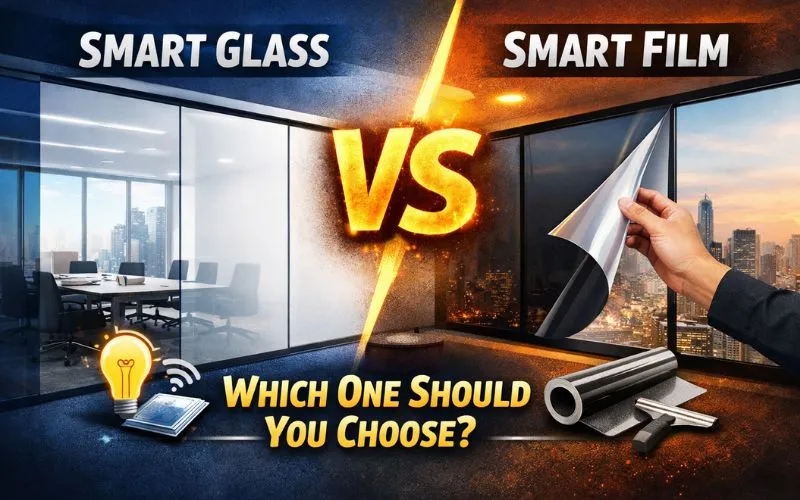
Smart film is more affordable and flexible, while smart glass is more premium but expensive. If you’ve been researching privacy glass solutions for your home or office in Pakistan, you’ve likely come across both terms, and found yourself confused about the difference between smart glass and smart film. Both technologies offer on-demand privacy, modern aesthetics, and impressive energy-saving benefits. But they work differently, cost differently, and are suited to very different situations.
Whether you’re renovating an existing space or planning a brand-new build, this guide will break down everything you need to know about smart glass vs smart film, so you can make the right choice with confidence.
Not sure how the technology works at all? Read our explainer on how smart glass technology works.
Ready to upgrade your space with switchable privacy glass?
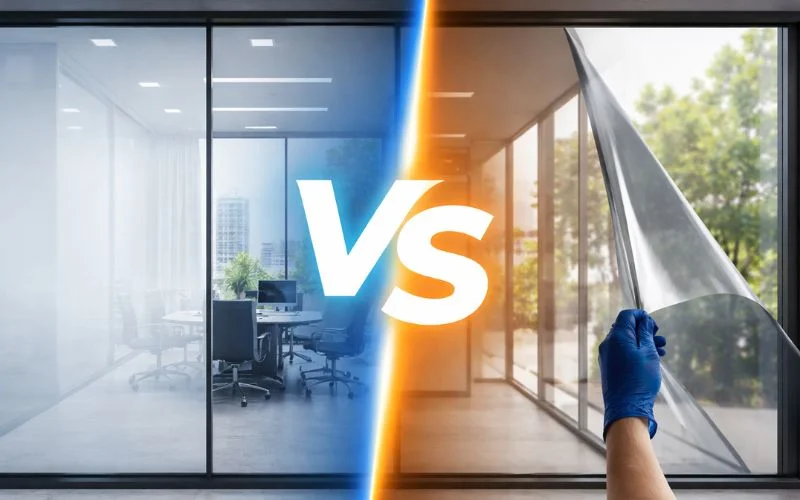
What is Smart Glass?
Smart glass refers to glass that has the privacy-switching technology built directly into the glass panel itself during manufacturing. When you apply an electrical current, the glass transitions from opaque to transparent, instantly. Remove the current, and it goes back to frosted.
Because the technology is embedded inside the glass, smart glass requires a full glass installation. You cannot retrofit it onto existing windows or partitions, it must replace the glass entirely.
Common Applications:
- Corporate offices and executive boardrooms
- Private hospital rooms and clinical spaces
- Luxury residential homes and high-end hotels
- ICU partitions and consultation rooms
Smart glass is the preferred choice when a project demands a completely seamless, built-in finish, typically in new construction or high-budget premium renovations. For a deep dive into specific applications, explore our guide to smart glass solutions for offices.
What is Smart Film?
Smart film (also known as switchable film or PDLC film) is a thin, self-adhesive privacy film that is applied directly onto existing glass surfaces. Like smart glass, it switches between opaque and transparent with the flick of a switch, but it works on any glass you already have.
This is the key advantage: smart film transforms your existing windows, glass partitions, or doors without any structural changes. No demolition. No new glass. Just apply the film, connect the power supply, and you’re done.
Common Applications:
- Office partition upgrades
- Home windows and glass doors
- Retail storefronts and display windows
- Hospitals, clinics, and commercial spaces
Smart film is especially popular for renovation projects where replacing glass entirely isn’t practical or cost-effective. Learn more in our comprehensive guide on how to choose the right privacy windows for your space.
Smart Glass vs Smart Film: Key Differences
The table below provides a side-by-side comparison of the most important factors when choosing between smart glass and smart film.
Which One is Better for Your Space?
The right choice depends heavily on your situation, your budget, your building type, and how much flexibility you need. Here’s a breakdown by space type.
For Homes
For most homeowners in Pakistan, smart film is the smarter choice, and the numbers back this up. Smart film can be applied to your existing windows and glass doors without replacing anything, keeping installation costs a fraction of smart glass. It also gives you the flexibility to upgrade or remove the film if your needs change.
Beyond privacy, smart film also helps with temperature regulation, reducing the load on air conditioning during Pakistan’s hot summers. Find out more about how smart film reduces electricity bills in residential settings.
For Offices & Boardrooms
Both smart glass and smart film are excellent for offices and boardrooms, but smart film wins on flexibility. Office spaces change. Teams grow, layouts get redesigned, and partitions need to be moved. Smart film accommodates these changes; smart glass does not.
That said, if you’re building a brand-new executive suite or a flagship office from scratch and budget is not a concern, smart glass can deliver an ultra-premium finish.
Read more about why boardrooms are switching to smart film across Pakistan.
For Commercial Spaces
Retail stores, restaurants, clinics, and showrooms typically already have glass installed. In these scenarios, smart film is almost always the preferred upgrade path, it delivers the same switchable privacy effect at a significantly lower cost, with minimal disruption to operations during installation.
Check out the growing range of uses of smart film in architecture and commercial design. Smart film is also gaining global recognition, ArchDaily’s coverage of smart glass in modern architecture highlights how switchable privacy solutions are reshaping commercial and institutional spaces worldwide.
Cost Comparison: Smart Glass vs Smart Film in Pakistan
Cost is one of the most significant factors in this decision, especially for the Pakistani market.
Smart Glass Costs
Smart glass involves manufacturing new glass panels with integrated PDLC technology, which means the cost is considerably higher from the outset. You’re paying for the glass itself, the built-in technology, the removal of existing glass, and the full installation. For larger projects, these costs add up quickly and can be prohibitive for most homeowners and small businesses.
Smart Film Costs
Smart film is dramatically more affordable. Because it applies directly to your existing glass, you eliminate the cost of new glass manufacturing and replacement altogether. Installation is faster, which further reduces labour costs. For budget-conscious projects, which describes the majority of residential and commercial upgrades in Pakistan, smart film is the practical, cost-effective solution.
For a detailed breakdown of potential savings, read our guide on how smart film saves energy costs over the long term. The U.S. Department of Energy also confirms that energy-efficient window solutions, including smart glass and film, can meaningfully reduce heating and cooling costs in both residential and commercial buildings.
Pros and Cons of Smart Glass vs Smart Film
Final Verdict: Which One Should You Choose?
The answer comes down to three simple questions: What is your budget? Is this a new build or a renovation? And how much flexibility do you need?
- Budget-conscious project: Choose Smart Film for lower upfront cost, easier installation, no need to replace existing glass.
- New construction project: Choose Smart Glass when starting fresh and wanting a built-in, seamless premium finish.
- Renovation or upgrade project: Choose Smart Film applied over existing glass with zero demolition and minimal disruption.
- Energy saving focus: Choose Smart Film, flexible, removable, and proven to reduce cooling costs in Pakistani homes and offices.
Smart film is the most practical choice for modern homes and offices in Pakistan. It delivers all the benefits of switchable privacy glass at a fraction of the cost, and with far greater flexibility for the realities of renovation and upgrade projects.
Frequently Asked Questions
Q: Is smart film cheaper than smart glass?
A: Yes, smart film is significantly more affordable than smart glass. Smart glass requires full glass replacement and involves higher manufacturing costs, while smart film simply adheres to your existing glass, making it the budget-friendly choice for most projects in Pakistan.
Q: Which lasts longer, smart glass or smart film?
A: Smart glass typically has a longer lifespan since the technology is embedded within the glass itself. However, high-quality smart film products also offer excellent durability, often lasting 10–15 years with proper care. For most residential and commercial applications, smart film provides outstanding value for its lifespan.
Q: Can smart film be removed?
A: Yes, one of smart film’s key advantages is that it can be removed and replaced if needed. This makes it ideal for rented offices, temporary installations, or spaces that are likely to be redesigned in the future. Smart glass, being a permanent installation, cannot be removed without replacing the entire glass unit.
Q: What is the difference between smart glass and smart film?
A: The core difference is how the technology is integrated. Smart glass has the privacy-switching technology built inside the glass panel during manufacturing. Smart film is a separate layer applied onto existing glass surfaces. Both switch between opaque and transparent on demand, but smart film is more affordable, flexible, and practical for renovation projects.
Q: Is smart film available in Pakistan?
A: Yes. Smart film is widely available across Pakistan and has become increasingly popular for both residential and commercial applications, particularly in Lahore, Karachi, and Islamabad. It is far more accessible than smart glass in the local market.