
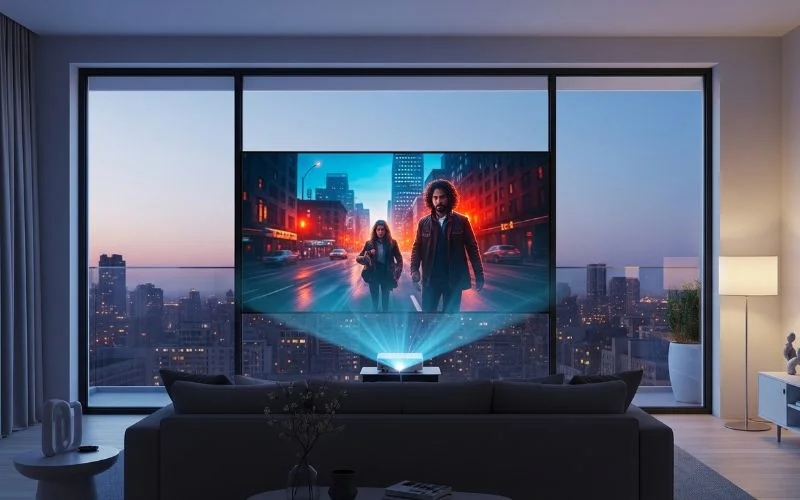
Home cinema setups in Pakistan have come a long way, projectors are more affordable, streaming is mainstream, and dedicated viewing rooms are no longer just for the ultra-wealthy. But there is one persistent frustration that even the best projector cannot solve on its own: the screen. Pull-down screens are bulky. White walls are never quite right. Dedicated projection walls mean permanent paint jobs and zero flexibility. Smart film solves all of this in one installation, turning any glass surface in your home into a flawless, switchable projector screen that disappears completely when the film is done.
Why Your Current Projector Screen Setup Is Holding You Back
A great projector paired with a poor screen is a wasted investment. The quality of the projected image depends enormously on the surface it lands on, texture, reflectivity, colour, and uniformity all play a role. Most home solutions compromise on at least one of these. Pull-down fabric screens sag over time. Painted walls carry texture. Fixed-frame screens dominate a room permanently and make the space feel like nothing else.
The Problem With One-Purpose Rooms
Dedicating a room entirely to home cinema means sacrificing that space for every other purpose. In Pakistani homes where every room needs to work hard, locking a living area into a permanent cinema configuration is simply not practical. Flexibility is everything, and smart film is built entirely around that principle.
How Smart Film Creates a Projector Screen on Any Glass
Smart film applied to a glass surface, a large window, a glass partition wall, an internal glazed panel, or even a glass door, switches between fully transparent and a clean, bright opaque white at the touch of a button. That opaque white surface is the screen. It is smooth, uniform, and purpose-built as a projection surface, because when smart film is in its white state, it provides exactly the kind of flat, consistent finish that a projected image needs to look sharp and vivid.
Make every room work harder.
Front and Rear Projection Both Work
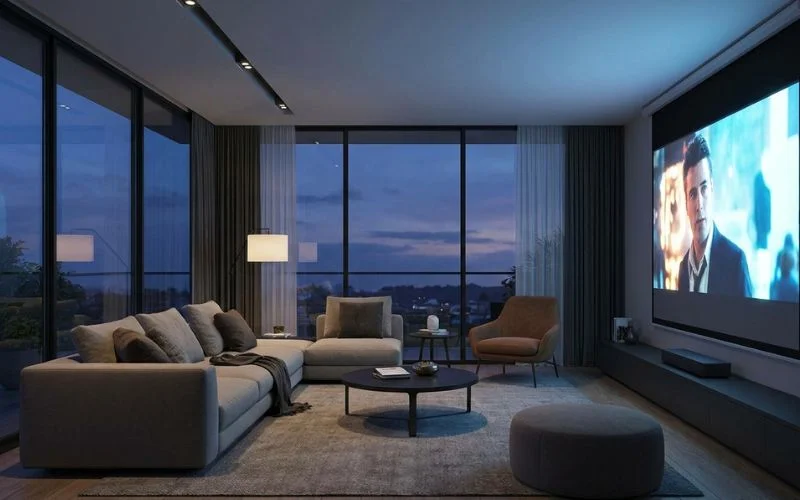
One of the most compelling features of smart film as a projection surface is that it supports both front and rear projection. Project from inside the room onto the glass, or project from behind the glass, both deliver excellent results. In a home with a glass partition between a living area and a study or corridor, rear projection creates a dramatic, cinema-quality image with the projector completely hidden from view. No cables trailing across the floor. No projector in the sightline. Just the image.
The Full Picture: What Smart Film Delivers at Home
The projection capability of smart film is remarkable, but it is only one part of what makes it such a powerful home upgrade. The rooms in your home that need smart film extend well beyond the living room, and the benefits stack up across every one of them.
Everything You Get With One Installation
- On-demand projector screen: Switch the film to opaque and project instantly, no setup, no unrolling, no adjusting a frame.
- Full transparency when not in use: When the film is clear, the glass is completely invisible, your room looks exactly as it always did, with no screen dominating the space.
- Front and rear projection capability: Flexibility to project from either side of the glass opens up creative installation options that a fixed screen simply cannot offer.
- UV protection for your home: Smart film reduces UV exposure through glass, protecting your furniture, flooring, and fabrics from sun damage and fading.
- Privacy on demand: The same film that becomes your screen also delivers complete visual privacy whenever you need it, a dual function that no traditional screen can match.
- App and remote control: Switch between transparent, private, and screen-ready modes using a wall switch, remote, or smartphone, instantly and from anywhere in the room.
- No structural changes required: Smart film applies directly onto existing glass with self-adhesive or non-adhesive options, meaning installation is clean, fast, and reversible.
- Over a decade of performance: Built with top-tier materials, the film maintains its projection quality and privacy function for years without degradation.
For homeowners thinking about the wider financial picture, smart film reduces your home electricity bill by blocking solar heat gain, making it an investment that pays back across multiple areas of your household budget, not just entertainment.
Planning the Ideal Smart Film Screen in Your Home
Getting the most out of smart film as a projector screen comes down to choosing the right glass surface and understanding how your room layout works with projection angles and ambient light.
Choosing the Right Glass Surface for Projection
The ideal surface for a smart film projection setup is a large, uninterrupted glass panel, the bigger the better for an immersive viewing experience. Internal glass partitions are particularly well-suited because they sit within the room rather than on an exterior wall, making it easier to control ambient light from both sides. If you are still weighing up options, how to choose the right privacy windows for your space covers the key considerations that apply directly to a smart film installation as well. Exterior windows work too, particularly in rooms where you can control light effectively, blackout blinds on adjacent windows combined with smart film on the main pane create a genuinely impressive setup.
Smart Film and the Modern Pakistani Home
Pakistani homes are evolving. Multi-purpose rooms, open-plan layouts, and the demand for spaces that adapt to different needs throughout the day are all shaping how families furnish and design their interiors. Smart film fits perfectly into this direction, and for glass surfaces like balcony doors, the combination of privacy, projection, and UV control in one film makes it one of the most versatile home upgrades currently available in Pakistan.
According to Projector Central, ambient light control and screen surface quality are the two biggest factors that determine home cinema image quality — both of which smart film directly addresses in a single installation.
Frequently Asked Questions
Does smart film produce a good enough image quality for home cinema use?
Yes. When in its opaque white state, smart film provides a smooth, uniform surface that is well-suited to projection. Image sharpness and colour accuracy are determined primarily by your projector’s output, the film itself delivers the consistent, flat white surface that projection requires, without the texture or imperfections found on painted walls.
Can smart film be used as a projector screen on any glass in a home?
Smart film can be applied to virtually any existing glass surface, windows, internal partitions, glass doors, or glazed room dividers. The best results for projection come from larger, uninterrupted glass panels in rooms where ambient light can be managed. Both self-adhesive and non-adhesive installation options are available to suit different glass types.
Does using smart film as a projector screen affect its other functions?
Not at all. Smart film switches between transparent, opaque, and screen-ready modes independently, you are not locked into any single function. The same film that serves as your projector screen in the evening provides full privacy during the day, UV protection around the clock, and complete transparency whenever you want an open, light-filled room.
Final Thoughts
A projector screen that vanishes when you do not need it, doubles as a privacy solution, protects your home from UV damage, and requires zero permanent changes to your walls or windows, smart film is not just a clever trick. It is a genuinely practical upgrade for any Pakistani home with a projector and the ambition to use every surface smarter. One installation. Multiple functions. Endless flexibility.