
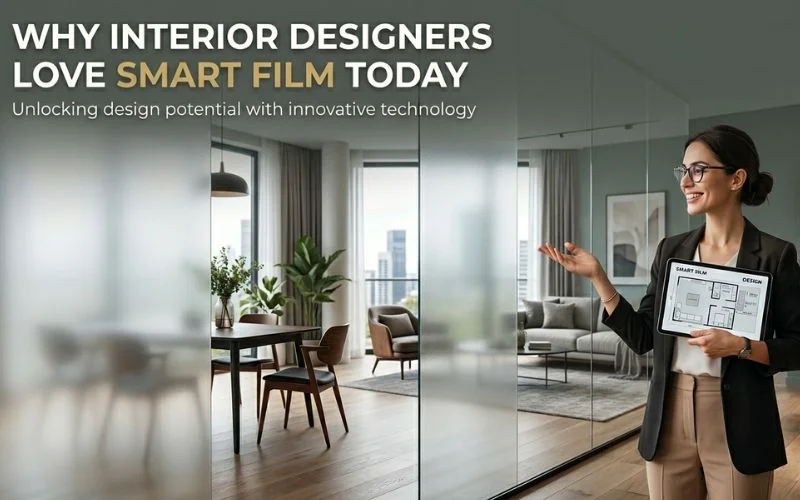
Interior design has always been about balancing form with function. The materials, textures, and technologies that designers choose define not just the look of a space, but how people experience it. In recent years, one technology has been making its way from high-end commercial projects into mainstream residential and commercial interiors: smart film. And once designers work with it, most of them never look back.
What Is Smart Film?
Smart film, also known as switchable privacy film, is a thin polymer layer that can be applied directly to existing glass surfaces. When connected to an electrical current, the film transitions from frosted to fully transparent within milliseconds. When the power is off, it reverts to an opaque, milky white appearance that blocks the view entirely. This instant transformation gives designers an entirely new dimension to work with, one that no curtain, blind, or partition can replicate.
The appeal is not just technical. It is deeply aesthetic.
Ready to upgrade your interiors?
A Tool That Solves Real Design Problems
Interior designers deal with constraints every day. Natural light is precious, privacy is non-negotiable, and spatial flexibility is increasingly demanded by modern clients. Smart film addresses all three without compromising the visual integrity of a space.
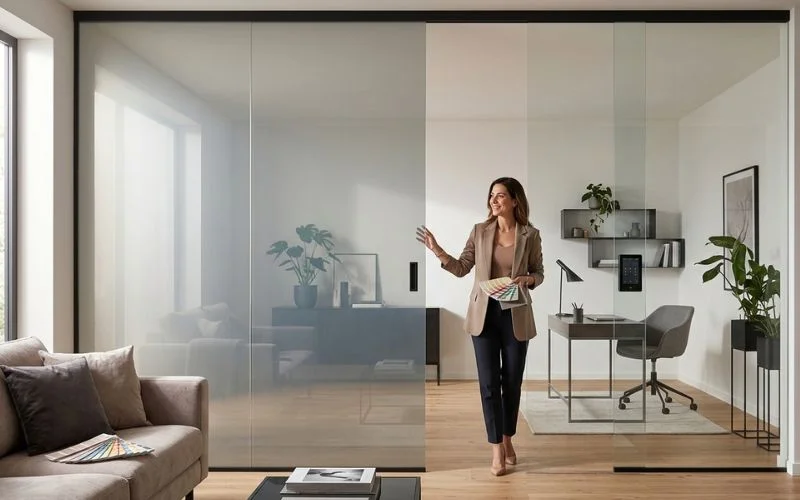
Unlike heavy drapes or mechanical blinds, smart film preserves the clean lines that define contemporary interiors. Glass walls stay glass walls, open, bright, and architectural, until privacy is needed. Then, with a single switch or a voice command, the same glass becomes a solid, elegant surface.
This is why smart film has become a go-to solution for hospital privacy settings, consultation rooms, executive offices, and any environment where discretion cannot be compromised but ambiance still matters.
The Flexibility Designers Have Been Waiting For
One of the biggest frustrations in interior design is permanence. Once a wall goes up or a partition is installed, changing the layout becomes expensive and disruptive. Smart film changes that equation entirely.
A glass partition fitted with smart film can serve as an open collaborative space during the day and a fully private room in the evening. Retail environments benefit just as significantly. Designers working on showroom glass installations can now transform static display windows into dynamic projection surfaces, creating branded experiences that shift throughout the day without any additional hardware footprint.
This kind of design flexibility was simply not possible a decade ago. Today, it is becoming a baseline expectation in premium interior projects.
Why Designers Prefer It Over Traditional Window Treatments
Smart film does not simply replace traditional window treatments, it outperforms them in nearly every measurable way. From maintenance to aesthetics to integration with modern building systems, the comparison leaves little room for debate. Designers who have made the switch rarely consider going back.
Key Advantages Over Blinds and Curtains
- No mechanical failure: Smart film has no moving parts, cords, rails, or motors that wear out over time
- Effortless maintenance: The film is cleaned the same way as any glass surface; there are no fabric panels to dry-clean or replace
- Space efficiency: Traditional window treatments take up visual and physical space; smart film sits flush with the glass and disappears entirely
- Uniform light control: Unlike slatted blinds that create uneven shadows, smart film diffuses light evenly across the room when frosted
- Integration with smart home systems: Smart film works with automation platforms, allowing designers to sync privacy settings with lighting schedules, occupancy sensors, and user preferences
For hospitality designers in particular, the shift has been dramatic. Hotel glass installations that once required custom drapery, blackout liners, and ongoing fabric replacement are now handled with a single, elegant glass treatment that lasts years without deterioration.
The Aesthetic Dimension
Beyond the functional advantages, there is something genuinely beautiful about smart film in use. The transition itself, that quiet, seamless shift from transparent to frosted, carries a sense of quiet luxury that clients respond to immediately. It feels like technology that has been designed with restraint, which is exactly what good interior design demands.
Designers who work on high-end residential projects appreciate that smart film allows them to maintain minimalist interiors without sacrificing practicality. A bedroom glass wall no longer requires a compromise between views and privacy. A bathroom partition no longer needs frosted glass permanently etched into it. The same pane of glass can offer both states, depending on the moment.
This versatility also extends into entertainment and media spaces. A smart film panel installed on a living room wall or ceiling-height glass partition can double as a projector screen, turning an otherwise passive architectural element into an active part of the home cinema experience. It is the kind of dual-purpose thinking that defines intelligent modern design.
Sustainability and Long-Term Value
The design industry is increasingly attuned to sustainability. Clients ask about materials, longevity, and environmental impact in ways they simply did not five years ago. Smart film performs well on all three fronts.
Because it is applied to existing glass rather than replacing it, installation has a significantly lower material footprint than full glass replacement or custom partitioning. The film itself is durable, with a lifespan that exceeds most conventional window treatments. And because it reduces the need for artificial lighting by managing natural light intelligently, it can contribute to a building’s overall energy efficiency.
According to the U.S. Department of Energy, smart window technologies have measurable potential to reduce heating and cooling costs in commercial and residential buildings, a data point that resonates strongly with environmentally conscious clients and LEED-focused projects.
The Future of Interior Design Includes Smart Film
The designers who are building their reputation on intelligent, future-forward interiors are already integrating smart film as a standard offering rather than a specialty item. The technology has matured, the installation process has become streamlined, and the price point has reached a level where it competes directly with premium traditional treatments.
For clients, it represents a tangible upgrade, the kind that is immediately noticeable and consistently satisfying. For designers, it is one of the few technologies that genuinely expands what is possible within a space rather than simply adding complexity.
Smart film is not a trend. It is becoming infrastructure for how modern interiors are designed, experienced, and lived in.