
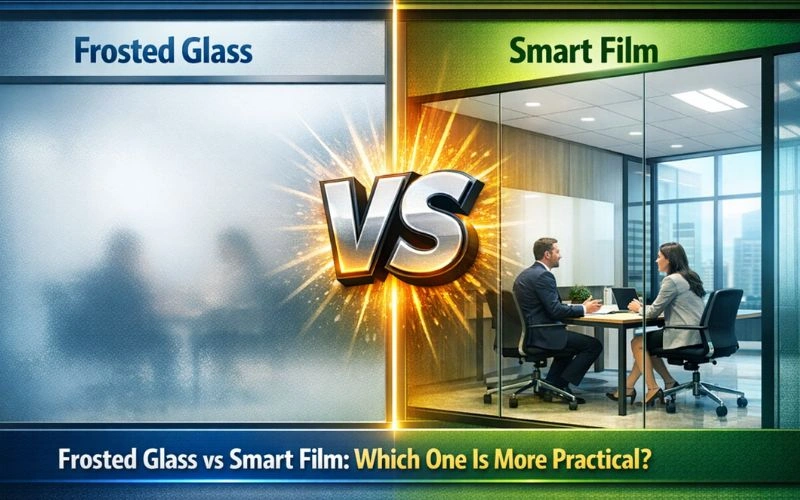
Frosted glass offers permanent privacy, while smart film provides switchable privacy with far more flexibility. For modern homes and offices in Pakistan, smart film is the more practical solution, it does everything frosted glass does, plus gives you the option to switch between clear and opaque whenever you need.
Frosted glass has been the go-to privacy solution for bathrooms, office partitions, and glass doors for decades. It works, but it is permanent, inflexible, and impossible to reverse without replacing the entire glass panel. Smart film applied to the same glass solves all three of those limitations.
This guide breaks down the real differences between frosted glass vs smart film across cost, flexibility, design, and long-term practicality, so you can make the right choice for your specific space.
Want expert advice on the right solution for your space?
What Is Frosted Glass?
Frosted glass is standard glass that has been treated to make it permanently opaque. The frosted effect is achieved through one of two methods: acid etching, which chemically roughens the glass surface to scatter light; or sandblasting, which physically abrades the surface to create the same diffused, translucent finish.
The result is a glass panel that blocks a direct line of sight while still allowing light to pass through, making it popular for bathroom windows, shower enclosures, office partitions, and glass doors where permanent privacy is needed.
The defining characteristic of frosted glass is also its biggest limitation: the frosted state is permanent. You cannot make it clear when you want light and views, and you cannot change the level of privacy it provides. Once installed, what you see is what you get, forever.
What Is Smart Film and How Does It Work?
Smart film is a thin, electrically controlled PDLC (Polymer Dispersed Liquid Crystal) film applied directly onto existing glass. When the film receives electrical current, the liquid crystals inside align and the glass turns completely clear. Cut the power, and the crystals scatter, making the glass opaque and private.
The key difference from frosted glass is that smart film gives you a choice. You are not locked into one state. The same glass panel can be clear during the day to maximise natural light, then switched to opaque for privacy in an instant, with a switch, a remote, a timer, or a smartphone app.
Installation does not require replacing the glass. Smart film adheres to the existing surface and connects to a standard power supply. The entire process is non-destructive and reversible.
For a detailed technical explanation, read our complete guide on how smart film works.
Key Differences Between Frosted Glass and Smart Film
The fundamental difference is control. Frosted glass is a permanent decision, you choose privacy once and live with it. Smart film is a dynamic solution, you choose privacy when you need it and full transparency when you do not.
From an installation perspective, frosted glass requires the existing glass to be removed and replaced with a factory-treated or site-etched panel. Smart film is applied directly onto the glass already in place, no removal, no structural work, and no extended downtime.
On cost, frosted glass has a lower upfront price. But it delivers no long-term value beyond basic privacy. Smart film costs more upfront and requires a power connection, but delivers switchable privacy, energy savings, and a premium design aesthetic, all from a single product.
Privacy Comparison: Permanent vs On-Demand
Frosted Glass: Permanent Privacy
Frosted glass delivers consistent, reliable privacy around the clock, which is exactly what you want for certain spaces. A frosted bathroom window or shower screen will never accidentally be left in the wrong state.
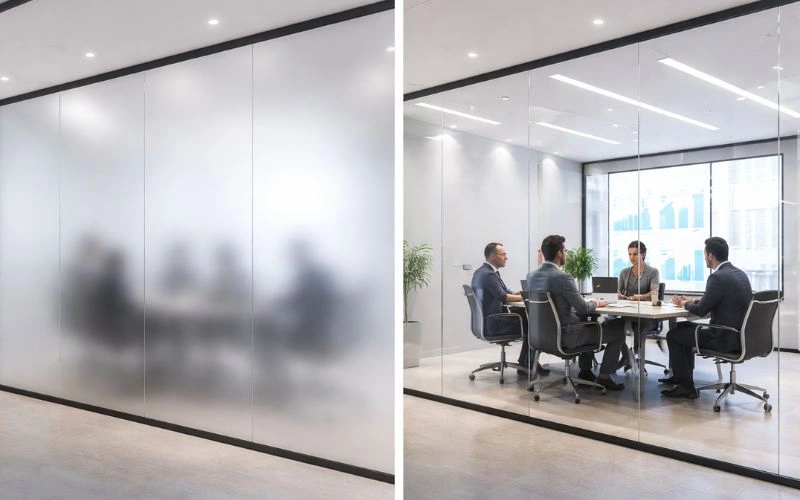
But the permanence is a double-edged characteristic. A boardroom with frosted glass walls is always private, even during empty hours when full visibility across the office would be beneficial. You lose the choice entirely. There is no dial to turn, no switch to flip, and no middle ground.
Smart Film: Adjustable Privacy On Demand
Smart film gives you the privacy of frosted glass when you need it, and none of the restrictions when you do not. A meeting room glass wall is clear and open during the working day, then switched to full opacity the moment a confidential discussion begins. A home bathroom window is clear in the morning to let in light and switched to private in under a second when required.
This flexibility transforms how a space can be used. A glass partition with smart film can serve as an open collaborative area and a fully private meeting room within the same square footage, something a frosted glass partition can never do.
For a full breakdown of what on-demand privacy means for your home or office, read about the benefits of privacy glass solutions.
Which Option Is More Practical for Daily Use?
Offices
In an office environment, spaces need to serve multiple functions. A glass-walled meeting room needs to be both open and private at different times. Frosted glass forces a permanent choice. Smart film adapts to the meeting schedule, clear between sessions, opaque during them.
See how smart film is being used in boardrooms and meeting spaces in our guide to smart film for meetings and offices.
Homes
In residential settings, the practical case for smart film is strongest in bathrooms and bedrooms. A frosted bathroom window provides permanent privacy but permanently reduces natural light. Smart film on the same window gives you full light during the day and full privacy in an instant when it matters.
Commercial & Healthcare Spaces
For clinics and hospitals, smart film wins decisively. Patient consultation rooms benefit from glass that is clear when the room is unoccupied, making it easy for staff to see availability at a glance, and instantly private when a patient is inside. Frosted glass removes that visibility permanently.
Cost Comparison: Frosted Glass vs Smart Film
Cost is where frosted glass appears to have a clear advantage, but only when you look at the upfront number in isolation. When you factor in long-term value, flexibility, and return on investment, the picture changes.
Frosted Glass Cost
Basic acid-etched frosted glass adds a modest premium over standard clear glass. It is the cheaper upfront option, but once installed, it delivers no additional value. If your needs change, the glass must be replaced entirely.
Smart Film Cost
Smart film in Pakistan costs between PKR 1,200 and PKR 2,500 per square foot including installation and wiring. It is applied to your existing glass, eliminating glass replacement costs. It also reduces electricity bills through solar heat management, a genuine financial saving across a Pakistani summer.
Return On Investment
Smart film lasts 5–10+ years, reduces energy costs, requires minimal maintenance, and adds functional value that frosted glass cannot match. For any space expected to be in use for three or more years, smart film delivers better long-term value.
Maintenance and Durability
Frosted Glass
Frosted glass requires almost no maintenance; the acid-etched or sandblasted surface is part of the glass and does not degrade. However, frosted surfaces show fingerprints and water marks more visibly than clear glass, and the textured surface can be harder to clean thoroughly.
Smart Film
Smart film is equally straightforward to maintain. The glass surface remains smooth, no texture to trap dust or cleaning residue. A soft, damp cloth is all that is needed. The electrical components require only periodic connection checks.
For a complete step-by-step maintenance guide, read our article on how to clean smart film properly.
On durability, frosted glass lasts as long as the glass panel itself. Quality smart film lasts 5 to 10+ years with proper care, and premium-grade products carry warranties of up to 10 years.
Which One Looks Better in Modern Design?
Frosted Glass
Frosted glass is a functional finish. It does its job and blends into the background, fine for utilitarian applications but uninspiring for premium spaces. The frosted surface has a visual weight that can make spaces feel more enclosed, with no dynamic quality and no ability to adapt to changing design requirements.
Smart Film
Smart film is invisible in its clear state, nothing to interrupt the glass line. In its opaque state, it presents a clean, smooth, uniform frosted surface that looks significantly more refined than traditional sandblasted frosting. For architects and interior designers working on premium residential or commercial projects, smart film has become the preferred specification.
Read about why interior designers prefer smart film over frosted glass and other fixed privacy solutions.
The American Institute of Architects (AIA) guidance on glazing in commercial design highlights how dynamic glazing solutions are increasingly being specified in place of static finishes across modern commercial and institutional buildings globally.
When Frosted Glass Might Be the Better Option
Smart film is the more practical choice in most scenarios, but there are genuine situations where frosted glass makes more sense.
- Very limited budget: If the upfront cost difference is a real constraint, frosted glass delivers basic permanent privacy at a lower cost.
- Permanently private spaces with no switching needed: A shower enclosure or a fixed bathroom partition that will always need to be opaque, and where you would never want it clear, is a reasonable application for frosted glass.
- Simple, low-priority partitions: In storage areas, utility rooms, or low-traffic service spaces where aesthetics and flexibility are not a concern, frosted glass is a cost-effective baseline.
- No electrical access: Smart film requires power. Where running wiring is impractical or prohibitively expensive, frosted glass removes that dependency.
The Glass and Glazing Federation’s technical guidance on privacy glass provides a useful reference for understanding when different types of privacy glass are most appropriately specified.
Final Verdict: Frosted Glass vs Smart Film
When comparing frosted glass vs smart film on practicality, design, flexibility, and long-term value, smart film is the stronger choice for the overwhelming majority of modern applications in Pakistan. The only category where frosted glass consistently wins is upfront cost, and even there, the total cost calculation over five years often favours smart film.
Smart Film Is the Better Choice If You:
- Want switchable privacy clear when you need light, opaque when you need privacy
- Are renovating an existing space no need to replace glass
- Want a modern, premium finish clean glass lines with no visible hardware
- Want long-term energy savings reduces solar heat gain and AC load
- Have a multi-use space offices, meeting rooms, consultation areas, open-plan homes
Frosted Glass Is the Better Choice If You:
- Have a very tight budget lower upfront cost for basic permanent privacy
- Need permanently opaque glass shower screens, fixed partitions, no switching required
- Have no electrical access smart film needs power; frosted glass does not
For modern homes and offices in Pakistan, smart film is the more practical, more flexible, and more future-proof choice over frosted glass, delivering everything frosted glass offers, and everything it cannot.
Frequently Asked Questions
Q: Is smart film better than frosted glass?
A: For most modern spaces, yes. Smart film provides the same privacy as frosted glass when switched to opaque, but also allows the glass to be fully clear when privacy is not needed. It applies to existing glass without replacement, reduces energy costs, and delivers a premium aesthetic. Frosted glass is only the better choice when budget is the primary constraint or the space requires permanently opaque glass.
Q: Which is cheaper, frosted glass or smart film?
A: Frosted glass is cheaper upfront. Smart film costs PKR 1,200 to PKR 2,500 per square foot, but applies to existing glass (saving replacement costs) and delivers energy savings and flexibility that frosted glass cannot. Over a 5+ year period, smart film generally provides better total value.
Q: Can smart film replace frosted glass?
A: Yes, smart film is a direct replacement for frosted glass in almost every application. It can be applied to existing clear glass to provide the same privacy effect, while also giving you the option to switch to transparent when privacy is not needed. Spaces that already have frosted glass can have it replaced with clear glass and smart film applied, gaining far greater flexibility.
Q: Does smart film last long?
A: Yes, quality smart film professionally installed typically lasts 5 to 10 years or more. Premium-grade films carry warranties of up to 10 years. With proper care, gentle cleaning and periodic electrical connection checks, smart film installations in Pakistan regularly exceed this lifespan.
Q: Is smart film suitable for offices in Pakistan?
A: Yes, offices are one of the highest-value applications for smart film in Pakistan. Glass-walled meeting rooms, boardrooms, and open-plan partitions all benefit from switchable privacy. The glass remains clear for an open, collaborative atmosphere during normal hours and switches to opaque instantly when a private meeting begins. Multiple offices across Lahore, Karachi, and Islamabad have already installed smart film as their primary privacy solution.