
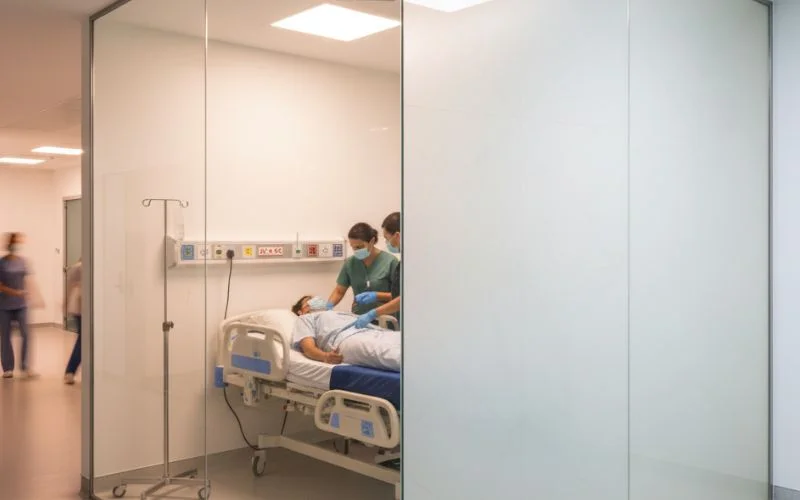
Privacy is not a luxury in a hospital; it is a fundamental right. Whether it is a patient undressing for an examination, a doctor delivering sensitive test results, or a family receiving difficult news, every moment inside a healthcare facility demands discretion. Yet many hospitals and clinics across Pakistan still rely on outdated privacy solutions: plain curtains that trap germs, frosted glass that blocks light permanently, or flimsy partitions that do nothing for sound and even less for dignity. There is now a smarter, cleaner, and more professional answer: smart film.
Why Hospital Privacy Is a Critical Concern in Pakistan
Pakistan’s healthcare sector is expanding rapidly, with new private hospitals, specialist clinics, and diagnostic centres opening in cities and towns alike. As these facilities modernise their infrastructure, patient experience and privacy compliance have become as important as clinical quality.
The Gap Between Traditional Solutions and Modern Healthcare Needs
Conventional privacy methods in Pakistani hospitals come with serious drawbacks. Curtains accumulate bacteria and require constant laundering. Permanent frosted or opaque glass cuts off natural light and can make rooms feel oppressive. Blinds and screens break down over time and look unprofessional. None of these solutions offers the flexibility that today’s dynamic healthcare environments demand, spaces that need to be open and collaborative one moment, and completely private the next.
What Is Smart Film and How Does It Work?
If you have not yet explored switchable glass film, the technology is remarkably simple to understand. Smart film is a thin, adhesive layer that can be applied directly onto any existing glass surface, windows, partitions, sliding doors, or interior panels, without replacing the glass itself.
Instant Privacy at the Touch of a Switch
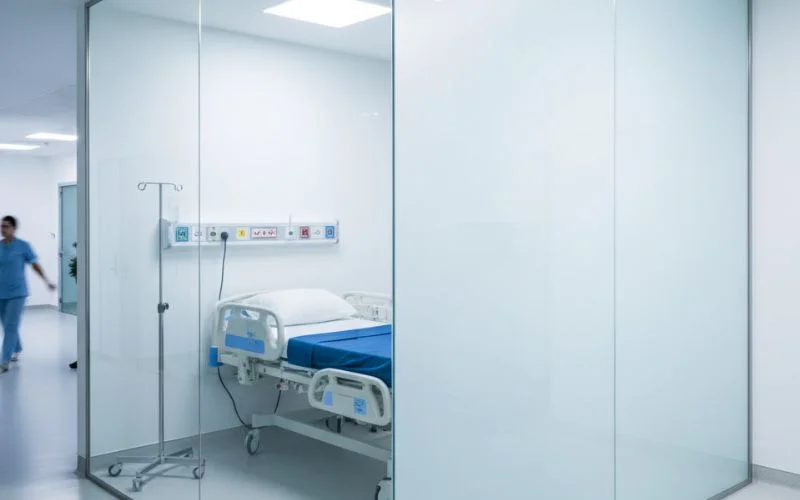
When powered off, the film turns a clean, opaque white, providing complete visual privacy. When powered on, it becomes fully transparent in an instant. This transition can be controlled using a standard wall switch, a remote control, a smartphone app, or even an integrated smart building system. No construction work. No replacement glass. Just a film that goes on your existing glazing and transforms how your space functions.
Ready to upgrade your hospital’s privacy?
Top Benefits of Smart Film in Hospital Settings
The privacy glass benefits in a clinical environment go well beyond basic visual screening. Smart film is a multi-functional investment that improves hygiene, patient dignity, staff efficiency, and the overall professional image of any healthcare facility.
A Smarter Way to Protect Patients and Staff
- Hygienic and easy to clean: Unlike fabric curtains, smart film has a smooth, non-porous surface that can be wiped down with standard hospital disinfectants, reducing the risk of cross-contamination.
- Instant, on-demand privacy: Consultation rooms, ICUs, patient wards, and recovery areas can switch from transparent to opaque in a fraction of a second, no fumbling with curtain rails or adjusting blinds.
- UV protection for patients: Smart film is designed to reduce UV exposure, protecting patients and interiors from harmful sun rays while maintaining access to natural light.
- Professional and modern appearance: Glass partitions fitted with smart film project a high-end, reassuring image that builds patient trust and enhances the overall environment.
- Dual function as a projection screen: When in its opaque state, smart film can serve as a projection surface for medical presentations, training sessions, or patient education, a two-in-one advantage that curtains could never offer.
- Durable and long-lasting: Built with top-tier materials for over a decade of reliable performance, smart film is a long-term asset for healthcare infrastructure.
According to the World Health Organization, patient safety and dignity are essential components of quality healthcare, and the physical environment plays a direct role in achieving both.
Where Smart Film Can Be Used Inside a Hospital
One of the strongest advantages of smart film is its versatility. It is not limited to a single room or application, it can be deployed across virtually every glass surface in a healthcare building.
From Wards to Consultation Rooms: Ideal Applications
- Patient ward partitions: Maintain an open ward layout while providing instant individual privacy for each bed area.
- Consultation and examination rooms: Glass-fronted rooms can remain open and welcoming when not in use, then switch to opaque the moment a patient enters.
- ICU and critical care units: Allow medical staff to monitor patients visually through clear glass, then switch to privacy mode for sensitive procedures.
- Radiology and imaging rooms: Eliminate the need for heavy permanent screening while ensuring complete patient privacy during scans.
- Reception and administrative offices: Manage confidential conversations and sensitive data handling areas with ease.
- Pharmacy counters: Offer patients privacy during prescription discussions without creating a closed-off, unwelcoming atmosphere.
Energy Efficiency — An Added Advantage for Hospitals
Hospitals in Pakistan run around the clock. Electricity costs are one of the largest operational expenses for any healthcare facility, particularly during the intense summer months. Smart film actively contributes to reducing that burden. By blocking solar heat gain through glass surfaces, it lowers the load on air conditioning systems, and that translates directly to reduced electricity bills. If you want to understand exactly how much difference this makes, explore how smart glass film can save you money on energy and why it is a financially sound decision for large facilities.
Why Pakistani Hospitals Are Making the Switch to Smart Film
Healthcare decision-makers across Pakistan are beginning to recognise that the design of a hospital environment is inseparable from the quality of care it delivers. Smart film offers a non-disruptive, cost-effective upgrade path, no demolition, no structural changes, no long installation downtimes. It can be applied to existing glass with minimal disruption to daily hospital operations. For hospital administrators looking to modernise older facilities or fit out new ones to the highest standards, electric window tint solutions represent an investment in both patient experience and operational efficiency. Whether it is a large teaching hospital in Lahore or a specialist clinic in Karachi, smart film is proving itself as the privacy solution built for the demands of modern Pakistani healthcare.
Frequently Asked Questions
Is smart film safe to use in a hospital environment where hygiene is critical?
Yes. Smart film has a smooth, sealed surface that is easy to clean with standard hospital-grade disinfectants. Unlike fabric curtains, which are known harbours for bacteria and require regular laundering, smart film can be wiped down quickly and thoroughly, making it a more hygienic choice for clinical settings.
Can smart film be installed on existing glass without replacing hospital windows or partitions?
Absolutely. Smart film is specifically designed to be applied directly onto existing glass surfaces. Available in both self-adhesive and non-adhesive formats, it requires no glass replacement and no major construction work, making installation minimally disruptive to an active hospital environment.
What happens to smart film during a power outage in a hospital?
In its default unpowered state, smart film is opaque, meaning it naturally provides privacy whenever there is no power supply. This is a built-in safety feature, ensuring that patient privacy is maintained even during unexpected power interruptions, which is a particularly relevant consideration for hospitals in Pakistan.
Final Thoughts
The healthcare spaces of tomorrow are being designed today, and smart film is at the heart of that transformation. For Pakistani hospitals and clinics that want to deliver a patient experience that is private, professional, hygienic, and energy-efficient, smart film is not just an upgrade. It is the standard. Contact Smart Film Solutions to discuss your hospital project and discover how this technology can be customised for your specific layout and requirements.